





{{ relativeTime(rv.updateTime) }}

{{ rv.comment }}
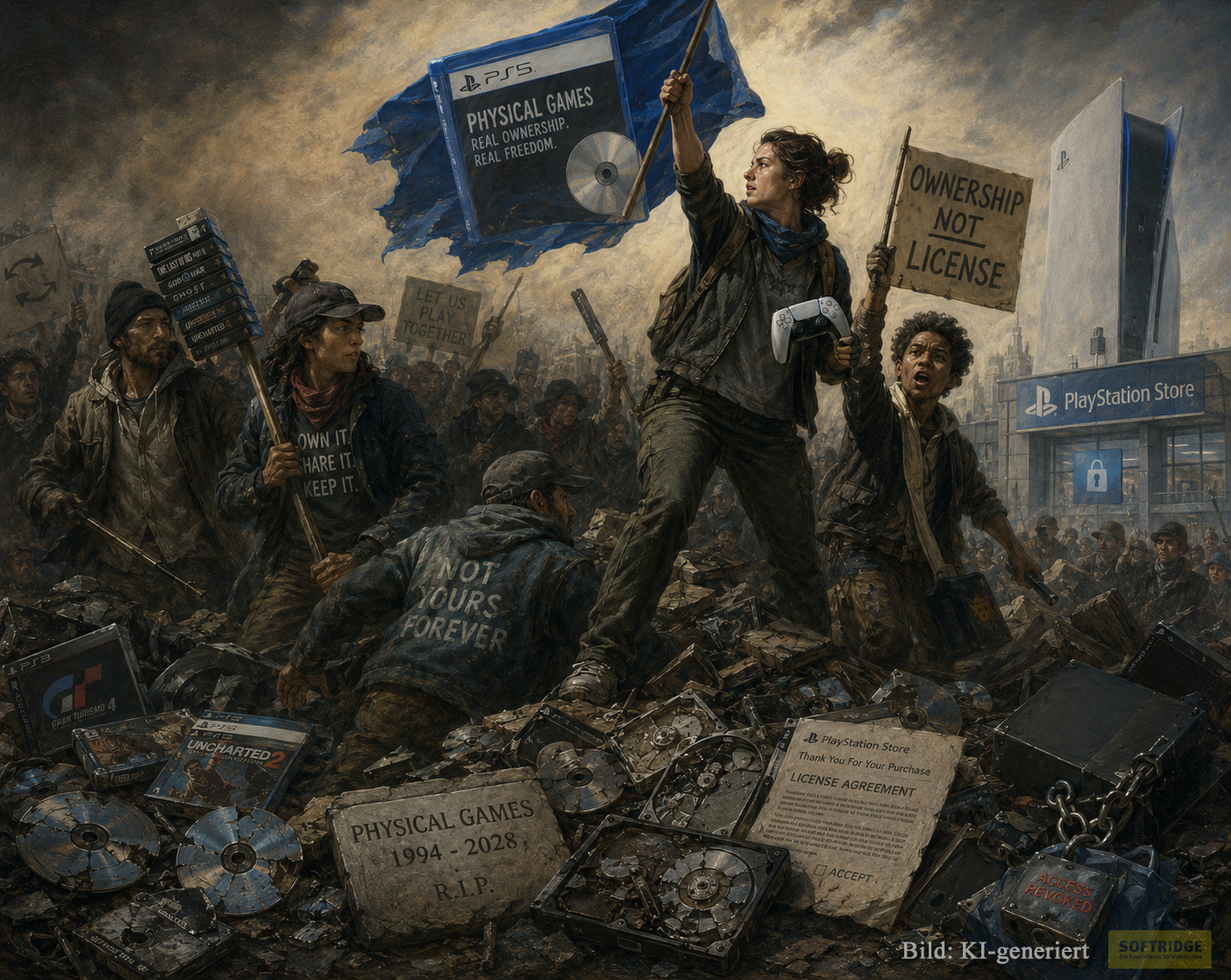
Image: AI-generated by Softridge
With the gradual departure from physical data carriers, Sony is continuing to drive the digital transformation of the video game industry forward – a development that is not without criticism. For many players, this step means less freedom of choice, greater dependence on digital stores, and the possible loss of key benefits of physical game ownership: being able to buy, collect, resell, or borrow games.
The specialist trade is also coming under increasing pressure as a result. Physical games have so far been an important part of its business model and often a central reason for selling consoles to end customers despite low margins. If this follow-up turnover is increasingly disappearing,
brick-and-mortar retail will lose an important economic incentive in the console business.
The decision exemplifies an industry that is increasingly relying on digital ecosystems.
and thus also bundles control over distribution channels, prices and availability.
Whether this development is in the interest of the players in the long term remains controversial. Among other things, ownership rights, the long-term availability of digital content and possible effects on pricing – for example through dynamic or more controlled pricing models – are critically discussed.
The following article by Rainer Etzweiler for Digitec Galaxus sheds light on the background to this development and shows what consequences it can have for end customers, collectors and specialist retailers.
"From January 2028, new Playstation games will only be released digitally. What sounds like a footnote for nostalgics makes gaming more expensive, insecure and monotonous for everyone. A classification.
The die has been cast: From January 2028, Sony will no longer press discs for new Playstation games. It was foreseeable that this day would come. Not that he comes so early. Both the industry and the community firmly expected that at least the next generation of consoles would once again take a two-pronged approach.
Sony buried this hope on July 1 with a meager PR announcement .
Sony justifies the step with the growth of digital purchases. Just 15 percent of all gamers still get their Playstation games physically. It is understandable that Sony, as a listed company, acts as economically as possible. But the consistency with which the company is pursuing this course is frustrating.
After Rockstar's decision to put "GTA 6" in stores without a disc, this is now the
second clear signal for a gaming future without physical data carriers.
Why this is bad news and what it entails.
A tradition disappears
My family never had a lot of money. We were neither poor nor did I have an unhappy childhood, but financially my parents had to make some compromises. Also with my hobbies. I had my own console, but until I was a teenager I only had very few games of my own. Many of my early memories are based on rented games and the challenges that come with them.
Marco wanted «Secret of Mana» back before I could defeat the Mana Dragon, the Sack. However, this has not scratched my love for the action RPG. I was happy to be able to play at all.
With the end of physical games for the Playstation, Sony is taking away one of its oldest social components from the medium – the borrowing and exchanging of games. At the same time, low-income earners lose the option of experiencing games at all.
But what happens when a game is lent to you not by a friend, but by Sony itself? Sounds strange, but in fact that's exactly what it amounts to as soon as you click on the "Buy" button in the online store.
Digital ownership does not belong to me
Nobody reads the software terms of use, which is why the persistent rumor persists
the games from the online store would be yours. They don't.
The contract you agree to when you buy makes it unmistakably clear: You get the temporary right to use a title: no ownership, only access. That's it. The pattern is identical across the industry: Whether Steam, Xbox, Nintendo or Playstation – practically all major platforms work with licensing models where you are allowed to play , but legally do not own anything in the classic sense .
Ironically, barely a week earlier, Sony itself had provided a strong argument for why this is problematic. In the UK, all Studiocanal films purchased disappeared from the media libraries of PS5 users – for "licensing reasons ".
What does this mean for games like "Spider-Man" and "Wolverine", which will be released in the fall, when Sony's Marvel license expires at some point – will the games also disappear from my library? The video game industry already has an archive problem: 87 percent of games released before 2010 are no longer legally available today.
Without physical data carriers, this situation is further exacerbated.
Gaming is becoming more expensive
Nobody can interfere with Sony's price when games run exclusively through the company's own marketplace. You don't need a crystal ball to find out why this is a bad development: "Spider-Man 2" currently costs 79.90 francs on PSN. On Digitec you can get the game for 47.90 and on Ricardo I found a copy for under 30 Stutz. It looks like a rabid marten has violated it, but that's exactly what underlines my argument: If my budget doesn't allow for any more, I can buy the marten bite version of "Spider-Man 2".
This option will no longer be available from 2028. If Sony thinks a four-year-old game is still worth 70 Stutz, you either pay 70 Stutz or you don't play it. Fuck you.
In the medium term, dynamic pricing is also likely to become a problem. The term sounds technical, but it means something simple. A price is no longer fixed. It depends on demand, time of day or, particularly unpleasantly, on your own buying behavior. Sony has already started the first test runs in the Playstation Store.
It's not just about Sony games
All Playstation discs, including those from third-party and indie publishers, run through Sony's manufacturing and certification. If the company turns off the press, it will affect every new title in the ecosystem - from first-party blockbusters to limited indie bangers. And Sony's announcement leaves no room for interpretation: It applies to all new games. From January 2028, the Playstation disc will be history as a distribution channel.
The collateral damage thus extends to micro and boutique publishers such as Limited Run Games or Super Rare Games, whose business model is completely based on physical releases. Some of them are likely to ask themselves these days whether this model has a future at all.
The decision will undoubtedly lead to fewer games, as the proceeds from physical versions are part of the budget plan of many indie developers.
Gameshops disappear
Admittedly, I'm a bit hypocritical here. I hardly move my fat ass to shops anymore and almost always have my goods sent to my home. But my hypocrisy doesn't change how sad I think it's that this step is another nail in the coffin for gameshops.
The stores are more than sales channels. They are community hubs, worlds of experience (keyword: midnight sales) and tastemakers. If they disappear, then part of the gaming culture will also disappear.
Are console gamers just babies?
PC gaming is 99.9% digital-only. A reflexive attitude of digital advocates is therefore often an indication of how established and accepted the practice is there. Fair point.
But: CD keys and one-time activations were already as much a part of PC games as the WASD control at that time. The change was also gradual. The PC gamer was the frog in the pot, not noticing how the water slowly began to boil, while console gamers are suddenly plunged headlong into the bubbling cauldron. No one has ever set a deadline for the PC from which physical data carriers are off the table, which is why the starting point is not the same.
PC gamers also have a choice: With Steam, Epic and GoG, there are two strong competitors. Steam is the clear leader, but the competition from Epic is good for the market and the fact that GoG is campaigning for DRM-free options is a silver lining on the otherwise dark horizon of the digital-only future.
In addition, console gamers have been paying attention and are rightly skeptical about the digital console future. The last ten years have been a shitshow: Games disappear forever from online shops, are suddenly unplayable or are only offered in expensive bundles to maximize profits.
The industry has proven time and time again that it can be trusted to
like a pop-up ad with "Singles near me".
Will there soon be no physical games at all?
Initial indications indicate that Microsoft will also do without the disc in the future. The Switch 2 successor is too far in the future for serious forecasts, although some optimism is appropriate here, because the distribution key does not (yet) look quite so bleak. Physical versions still account for a good 40% of sales here.
A look at other media also gives hope: Books have not been replaced by e-books to this day, about three years ago I wrote about the vinyl comeback on another platform and recently even cassette sales picked up again.
You can dismiss this as a niche market for a few romantics. But it also shows that the need for physical possessions cannot be dictated away. And where there is a need, sooner or later a market will emerge.
Grand Theft Game
This is not meant to be a plea to hold on to the past.
At some point, the carriage drivers had to accept that they would be replaced by the car.
If you don't keep up with the times, you go with the times.
Considering how amateurish and customer-hostile the gaming industry is,
However, if we have dealt with digital ownership so far, a large portion of skepticism would do us all good.
This applies not only to die-hard fans of physical media like me, but to all gamers.
Because if consumer rights are continuously undermined, at some point only an empty shell remains.
A bit like the retail version of "GTA 6".
Note: This article refers to the article "Game Over for the Disc: Sony's Digital Compulsion Affects Us All",
which was written by Rainer Etzweiler for Digitec Galaxus. Source
What our customers say
{{ relativeTime(rv.updateTime) }}
{{ rv.comment }}
Why order from SOFTRIDGE?

Assortment
More than 4,000 products available from stock!

Fast delivery
Order by 17:30 and receive your products the next working day. (only for available products)

Free Shipping
We take over the shipping costs including Track & Trace from an order value of CHF 50.–.
Why shop at SOFTRIDGE?

In-depth expertise
Competent advice with over 20 years of experience.

Open 364 days a year
In Zurich at the main station, we are there for you 364 days a year.

Trade-In
We buy your used consoles & video games, and we also have a wide range of second-hand products.
About Softridge
Help & Contact
Service
WhatsApp & Social Media



Online Payment Methods & Shipping





 Share
Share
 Route
Route
 Call
Call